Blog

  • UTMB 2026

    UTMB 2026

    This race is one that I spent two years training for. I had completed the loop one time, had finished a shortened version due to a storm and had one DNF. Even when I finished in 2013, I was pretty unprepared, or I should say ridiculously unprepared for the terrain of les Alpes. I hired a coach, Leif Godberson of Evoke Endurance, as somebody who is experienced in navigating mountain terrain, and vertical challenges that I don’t have available to train on here in Oregon. Left to my own devices, I don’t have the confidence that I could have trained as specifically as I did with Leif. I had attempted one of the UTMB races last year, the Sur les Traces des Ducs de Savoie, (TDS) and had to stop at mile 80 of 95 due to a strained hip flexor. I spent the next year building off of what we started plus visiting my PT on a more regular basis, getting me to the race in good shape.

    I went out to Chamonix Valley about 2 1/2 weeks before the race to reacquaint myself with the long steep climbs that I would be encountering during the race and to eat as many good baguettes and croissants as possible. I ran a fair bit of the last 20 miles of the course as well as the first 14 miles. I had some recollection of the course from when I ran it 13 years ago and mostly recognized just how long the climbs are.

    About a week before the races started, the town of Chamonix and Les Houches (where I was staying) definitely picked up in the number of runners trotting around on the streets with their packs and poles, and the excitement definitely rose few levels. I didn’t get too wrapped up in any of the activities but focused on getting the things done that I needed to while following all the other races that were happening during the week. I did, however, enroll in one of the research studies being conducted during the race – a sleep study measuring stress, sleepiness, alertness, and a few others (subjective) and a response test (objective) that would be conducted at a few of the aid stations.

    Finally, race day arrived, or should I say race evening, as it was scheduled to set off at 5:45 PM – and due to potential storming up at the higher elevations, the start was postponed for two hours.

    Above – a graph of the course with elevation and distance.

    Below – a topography of the loop around Mont Blanc.

    At 7:15, I squeezed in with the masses of a good 2000 trail friends and watched the elite runners as they were individually introduced to the pulsing crowd. A light rain was subsiding, and the temperatures were very comfortable.

    Finally, the countdown was on and off we went through the town of Chamonix.  The crowd lined both sides of the streets, all the way out of town. It felt like a hero’s parade with all the cheering – it was quite an experience! It felt like we were winning rather than just starting our epic journey.  

    After about 2 km, I heard some voices shouting out “a gauche! a gauche!” – “to the left! to the left!” as there was a team of guides that were that were assisting a person in a wheelchair for a category called “team adaptive”. It was allowing some wheelchair bound folks the opportunity to experience the loop around Mont Blanc.  It was pretty unbelievable, honestly, to imagine that they were going to go all the way around. As they went by me, I could see they had long straps to help pull the chair when it got tricky.

    The first few kilometers are fairly flat and a lot of was on payment, still surrounded by spectators cheering us along. I ran nice and easy, over the fairly benign climb into Les Houches, getting my legs warmed up for what was ahead. It was already dark as we ran through the little town. At the far end, we began our first major climb, starting up a gravel ski road. The crowds were still quite thick – it felt like everybody was having a party and we were their entertainment! Maybe that’s exactly what it was.  Eventually, as always, we made it to the final top of that first climb of Col de Voz and began the descent. It started down stupidly steep on a grassy trail – I had run down this last week and sharpened my skills so that I danced my feet very quickly to stay in control without putting on the brakes, skittering past several runners.  The slope mellowed and the long descent took us into San Gervais, about 23 km in. The town was electric with spectators which put a smile on my face to have so much cheering.

    Into the aid station, I quickly pulled out my bottles to fill with the race provided sports drink – Näak. I ran up to a volunteer with a pitcher in his hand and I asked if it was Näak. He said no –  it is at the other end of the tent. So, I trotted  down to the other end of the long tables and asked for Näak and they answered was no it’s at the other end of the table, so I went back to the other end and told the man and he gave me a blank look. I asked the woman next to him and she said “oh – we are out of Näak”. Well, that was not a very fun surprise, and I spent a few minutes being a little grumpy about it – especially since that was what I was counting on for the race. Instead, I filled one of my bottles with Coke and the other one with water.  The rain had stopped and I took my jacket off and stuffed in my pack. I really need to use the bathroom so I asked where the toilets were. “at the end of the aid station.” I ran out again to the cheers of the crowd, looking for the toilet, never did see it and just kept going. I reset my attitude regarding my resupply to that of gratitude for being here and grateful for all the volunteers, whose fault it wasn’t that they ran out of sports drink. Eventually, when we were out of town far enough, I turned off my headlamp and went way off the trail and squatted by the bushes.

    Back up and running, I was quite pleased with my energy. I kept it nice and relaxed but happily ran along. Even on the narrow trail and on some climbs, I passed several runners without overexerting myself. Finally reaching Les Contamines (32 km), I was happy to discover that this aid station did have Näak and so resupplied and trotted off to the next climb. This section included a pretty long stretch where we were required to have our lights set on the red beam as we were going through a nature preserve with sensitive wildlife.  This section is also on the remains of ancient Roman road that has a lot of really wide slab rock, and a lot of broken up rock. Some of it was a little technical and using just red light, (mine in particular), it was a little bit slower than it probably would’ve been. After about an hour of climbing, it was cool to turn around and see a stream of red lights coming up the mountain side.

    Once we got to the next col, we were allowed to go back to white light. The climbing wasn’t quite over (never trust you’re at the top of anything in this race!) and the next section rolled up and down with a lot of bouldering types of steps, which, surprisingly, I actually quite enjoyed. The descent finally started at Refuge de la Croix du Bonhomme, into Les Chapieux, a remote high-altitude alpine hamlet in southeastern France, still in the dark. This was just over 50k and not quite 10 hours in. During the next climb, up to one of the highest points to Col de la Seigne  (about 2200 meters, or over 8000 ft) – right on the border of France and Italy – the sun came up and I could see the line of runners before me, and the peak eluding my vision by hiding behind the turns in the trail.

    The descent took us down into the Val Vany. I looked to my left, and my spirit soared at the view – the mountain range felt enormous, and that I had been transported here in some otherworldly fashion, as I floated into the aid station at Lac Combal (67 km).  I repeated my routine having my bottles filled with Näak.

     The next section started off on a runnable road to a single track to begin our climb to Arête du Mont-Favre, another long climb where we encountered many hikers who were perhaps hiking the TMD (Tour de Mont Blanc) and were probably getting a little bit annoyed at having to get out of the trail.

    The runners I was around and myself were as polite as we could be, knowing that it could be quite irritating and that we all need to share the trail. We even passed a pack mule completely loaded down with supplies for one of the groups.  He seemed a little bit reticent at times, and the guide was definitely having the pull him along.

     After the summit, we ran down to Checrouit Maison-Vieille, a lovely Italian aid station where the very Italian women tried to serve me lots of pasta and good sauce – I accepted sans the cheese – just not quite ready for that. I ate it under a tent chatting to a charming Italian man, asking him about the leaders, while he encouraged me to keep eating, then pointed me to the trail that descends into Courmayeur.

    This part I recognized from training for TDS last year, and I was looking forward to what I anticipated being a pretty straightforward road descent. I was to be disappointed. We ran to a ski lift and then we were led to single track. I classified this descent as the worst one of the race. It was narrow. It was really steep. It was full of switchbacks, roots and rocks and toe jamming slopes. I ran this descent in 2013 and wrote about it, however it was in the dark that time, and I had younger legs. We finally reached the town of Courmayeur, halfway around Mont Blanc (81 km), and into the aid station.

    Here I was met by the organizers of the sleep study who asked me what they could get me while I answered some subjective questions and then sat at a computer for a response time test – 3 minutes of clicking whenever I saw a red dot, and my response was measured in milliseconds.  The sports center was cramped with people and they knew how to quickly get what I needed.  I ate a cup of soup with noodles, and took off my tights and my long sleeve shirt as it had gotten quite warm and sunny out. It felt nice to be free the clothing. On my way out I was bombarded by some young volunteers enthusiastically offering to spray me down with sunscreen for which I was very grateful.

    I ran up the cobbled and paved streets of Courmayeur and as I got close to the trail head, I saw the familiar face of Andy Pasternick, the medical research director from Western States and his wife, Joanne and Joanne‘s mother and Tammy Hew-Butler.  When they saw me they were very excited,  jumping up and down, cheering for me, and I yelled “I have fans!” It was a truly uplifting moment.

    Getting on the single track out of town, I slowed my roll, keeping in mind how much climbing I had left to do. I basically inched my way up and allowed several people to go around me.  This section was almost like going up stairs versus a smooth trail and I told myself “Go as slow as you have to go in order to have a strong finish.” I finally reached refuge Bertone (87 km), where many of the runners who had passed me were now laying down in the grass enjoying a relaxing time. I took my time to get my bottles filled and to drink a little more while at the station. I then began the hike out to hit a rather flattish section that would go on for about 7 km all the way to refuge Bonatti. It was up here that I encountered another of the adaptive runner teams. It was amazing to me that this group of people was getting a person around on this course in a wheelchair. We were fairly spread out now and I was moving comfortably. My energy and fitness felt on point.

    At the end of the flat section, we descended to Arnouvaz (99 km) in the Aosta Valley. I fueled up inside the aid station and saw there was live race coverage on a screen – the top men had finished, and the top three women were getting close. I was absolutely thrilled and surprised to see that my friend Emily Schmitz, an American living in Les Houches, was coming in 3rd! Later when I spoke with her, she said everything just clicked and no one was more surprised than she. With that uplifting bit of news, I began our longest climb – the Grand Col Ferret, which marks the border between Italy and Switzerland. I kept myself in check, never flagging, just steady, steady, steady, never tiring of the views to my left of the magnificence of it all.  Each time we came around a bend in the trail, and I could still see runners above me, rather than internally complain, I just described it to myself as “we’re not there yet”. I was very grateful for the training I had done to prepare me for this.

    On the descent I was moving comfortably enough when a young woman caught up to me and began a conversation. She was also in the sleep study and was the mother of some young children. We hit a nice pace and decided to stay together. It was super helpful and the conversation helped pass the time. Her name was Sarah, an expat living in the Chamonix area, and this was her first 100 miler. She was wanting to get to the next aid in the town of La Fouly quicker, so she could breastfeed her baby. With a new breast-feeding policy, her crew was allowed to come into aid stations with the baby – a great positive move for the race that further helps women be included in this sport.

    Before we got to La Fouly we agreed that it would be nice to have each other as run buddies for the rest of the race if it worked out.  Just before the aid station (114 km) her husband and three daughters were out waving us in. Inside the aid station it was hot and loud and smelled bad – I mean we had a lot of sweat going on between all the runners and the roughly 70 miles we had covered. I tend to get a little lost in the aid stations trying to figure out what sounds good – I found some rice that I had broth added to, but the rice was so hard I couldn’t manage it. Then I spotted a Swiss couple making small plates of raclette – melted cheese – that would be served with a potato and a pickle. I had no desire for the cheese or pickle, but I was pretty excited with the prospect of a potato. I asked the kind man, if I could have just a potato. No. Only a plat du jour. Given that would give me 2 items I didn’t want to eat and one very small potato, I walked away. I got my bottles filled and as it was getting dusky, decided I should start drinking a bit of coffee going into the second night. Sarah needed more time and told me to just leave without her, and she would try to find me later. I was getting a little bit chilly so put on a few warm clothes and decided I had better keep moving.

    This next section was slightly downhill and it was runnable. I was so pleased with how my legs felt and worked. With the help of runners around me – although we were finally fairly spread out – we all made it through a small town finding the markers almost like hash running. We finally hit the trail – a 3 km climb that was long and rocky that finally took us up and then over to the cute lake village Champex Lac (138 km).  The sleep study folks were here for the subjects to do another response time test, and while I did so, they again got my bottles ready for me. Sarah had not caught up with me at this point, but I knew I needed to just keep moving. I started walking out and realized I had paid no attention to how far the next aid was. I asked a couple of men in the race – they didn’t give me a distance but said four hours. I thought wow, that seems long.

    The first part of this was in the trees and not terribly unrunnable, but it was dark. Then we began to climb. I was pretty excited because I knew at some point in this section I would catch up to the point I had been on just the week before, and I would know what the rest of the race was going to be. We finally crested and as we were coming down, I was thinking – “oh this is where I was just last week”. I’d look at my watch and think the two men had been far off the time prediction. This was followed by the thought “boy I don’t remember this rocky section” and then I realized well it’s because I wasn’t actually as far as I thought I was.  This went on for quite some time, even when I could see lights below and thought we were close to Forclaz, which sits above the next aid station, I realized I had not been out near as far as I thought.  I caught up to a woman who was delicately getting over the rocks and asked me if I wanted to go around. I said no, it was just a slow section and soon it would level out. And it just kept going. We finally did hit familiar trail, but it was still rocker than I remembered – accentuated by my headlamp illuminating the rocks to a bright white, surrounded by darkness of the ground below – which made me more timid than I liked. But I’m also sure it had something to do with how many miles I had my legs at this point.

    We came to a water only aid, really close to a cattle barn that was a bit on the smelly side. I didn’t need anything, so I kept going and the volunteer said it was 5 km down to Trient.  We finally got to Forclaz and from there it was quite an easy run and descent into Trient – the Swiss village with the pink church.

    This was another sleep study stop. One of the questions we are asked each time is “have you slept at all?” and “are you planning on sleeping?” As I have never slept in a race, the interviewer said that most people in the European races do stop and take naps. She also said if she were going to do an ultra that involves sleep, she would never sleep inside one of these sleeping tents or use one of these blankets because they were so disgusting by the end of the race. I finished the test (my response time was noticeably slower and took more focus as at this point, 28 hours in, I had been awake for 38) and then went into the aid station, ate some soup and loaded up my bottles and was on my way. This time I certainly knew the rest of the course. Ahead of me next was probably the steepest climb of the race, but it was not nearly as long as some. I started to go a little bit hard and then realized that it wasn’t going to be sustainable. A couple of men behind me got right on my heels, so I pulled over and let them go by only to find them sitting on the side of the trail about two switchbacks later, having a bit of a rest. So we played that game a little bit, and I was pleased to have kept my effort sustainable. It was getting close to the next morning and when I started the descent where I had encountered my lovely flock of sheep a week before. It’s a nice descent – however I was starting to struggle a little bit with the whole being awake for however many hours at this point. I kept shoving the idea out of my mind of stopping to take a nap at Vallorcine, which was the next station. At the same time, it sounded so lovely to just close my eyes for a little bit. And the other part of me would say “well then how long do you think you would stay asleep?”  and “how’s it going to make you feel when you wake up?” and “are you going to want to keep going or are you going to want to quit?”. While I didn’t feel particularly unsafe. I also was aware that I needed to be extra careful with just my level of alertness. When I finally descended into Vallorcine (155 km), it was now light. And just as I had hoped, the second sunrise woke me up a little bit. It also made me feel just a little bit nauseous and I realized I was having a hard time getting calories in. I wandered around in the station and the only thing that looked remotely good were some crackers. I grabbed a handful and walked out of the aid station, nibbling on them and found that they settled my stomach and I could drink more calories.

    I didn’t really want to have any time goals for this race – the older and slower I get, the harder it is to make predictions. I had a range of time that I thought was a reasonable expectation if everything went well. That range was to finish between 33 and 40 hours – I know that’s quite a long range, but I am a different runner from 13 years ago. This was uncharted territory in terms of how long I’ve ever spent doing one event.  I looked at my watch, and I was now at 35 hours, and I had 17 km to go. I didn’t want to care, but I couldn’t help myself – I was unsure if I could actually run 17 km in five hours, but apparently I sure wanted to be under 40 hours. It seems a little bit crazy to doubt it I could do it, but I knew that I’d have to do more than walk because there was still another climb and a descent that was very difficult. I found my body sort of taking over and saying well, let’s do this. And so, I hiked hard and ran when I could, and when we got to the climb, I went up solidly. I never got discouraged, but the following descent (I classified as the second worst)  was probably slower than the climb. The drop-offs and step downs were very challenging, even for me who has relatively long legs. I felt like this had been put in the race as mean trick to see how hard the race could be made. When I finally popped out at the bottom, we were off for more climbing. Even though I had done this section the week before, I really had completely forgotten how long this climb would become. I was super motivated though and worked hard as if the top were around the next corner. It was never around the corner. I saw a runner ahead of me and every time I thought he was getting to the top and I would hallucinate some object that would indicate that it was the trailhead he would turn to keep going up and that object would disappear. Of course, we finally did that to the actual real sign that put us out onto the open section and service road up to La Flégère at last.

    I had worked really hard to get there and now I had sort of run out of gas. I found a gel and started to nibble at it, and it helped me get to the tippy top. When I tried to swallow the last little bit, I almost had my very first ultra marathon puke. So I did not try to finish it and stuck the sticky mess into a pocket.

    The last aid station was La Flégère and the sleep study folks were there. I told them I didn’t want to do the final test because at this point it looked like I could even run under 39 hours. My competitive mind just would not let go. She asked me the subjective questions and while doing so I took off my warm clothes again because it had gotten quite warm.

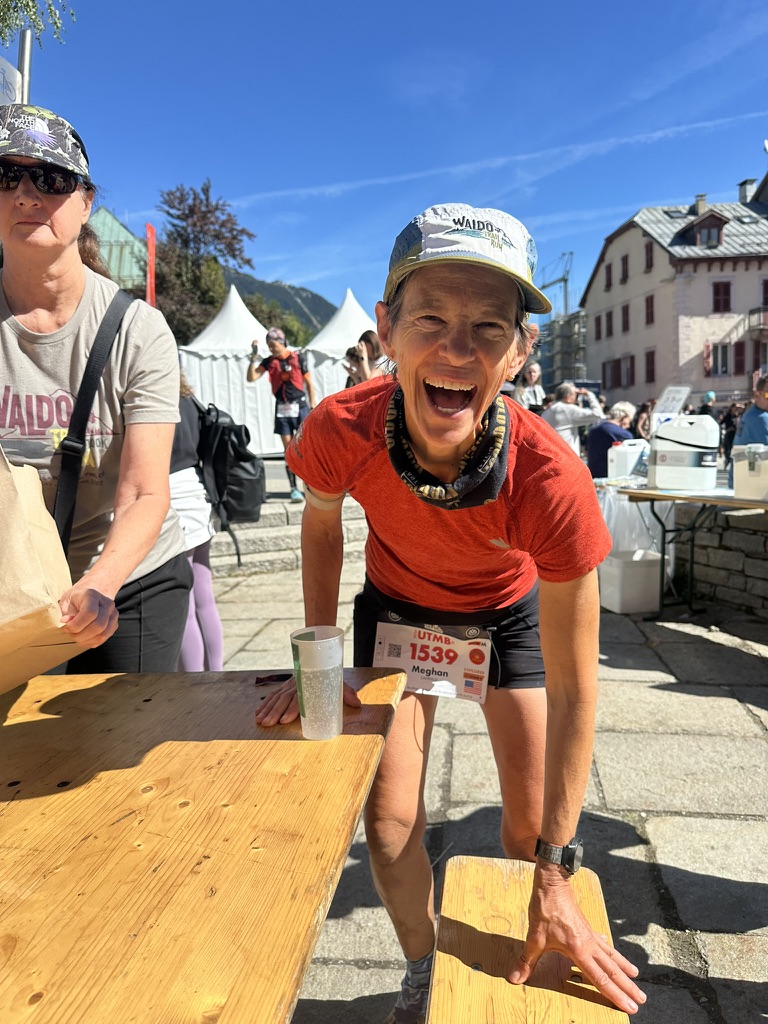
    When we were done, I headed off down the gravel road just letting my legs go. I was so pleased to be able to run and when I got on the single track I caught up to another runner, Stieven, who asked me if I wanted to go around  – I said no because I really liked his pace and didn’t want to lose a tooth. He was moving at a very good clip which allowed me to focus on where his feet were landing and I did not have to think over the technical bits. We continued on this way for about 3 miles when we finally hit a bit of straight gravel road and I just let her rip. I thought maybe Stieven would keep up with me, but he did not. I was so excited and got down to the very bottom to go over the makeshift bridge that had been put in for the race to go over one of the main roads. And then I was in town on very flat pavement. And boy did I feel flat – yet so close to the finish. I knew I might as well just keep pushing hard. I made my way along to the cheering crowd and I looked up at Mont Blanc and my eyes welled up thinking I fucking made it around this mountain. And then looking back to where my feet were going the tears never came, all the drama was gone, and I was just happy.

    Just before the finishing line I spotted Craig on the sideline cheering for me, and then around the corner I went, under the arch where the announcer said “here is Meghan Canfield and she will be on the podium as she has just won the 65 to 69 age group category. And you don’t look a year over 40”. I could’ve hugged her. I may have.

    I was so happy to have completed the loop, so satisfied with how the training paid off, and content with my decision to not run this race again. I found the technical downhill rocky sections too stressful to really enjoy, and if you can’t have fun….

  • Old Ghost Road 85K 2025

    Old Ghost Road – When the Whole is Greater than the Sum of the Parts

    Originally published in the June/July 2025 issue of UltraRunning Magazine

    “What do all the acronyms mean on your graph?” came the question from the audience. It was the end of the prerace briefing for the Old Ghost Ultra 85k, where the race director, Phil Rossiter had entertained and delighted us with logistics, gear requirements, how much a helicopter ride out would put us back, and a hilarious graph of what a typical ultra runner might go through during the race. While he had made clear that WTLI stood for the Will To Live Index and how it would go down during the course, be elevated by the lovely aid station volunteers, but generally decline over the day, there were a few lines left unexplained.

    As I left the theater, I commented to my friend/crew Michael Pullar, that actually the race briefing was enough, I was satisfied and could go home.

    Of course I was kidding, but the meeting left me with a feeling of awe in what the race organizers, and more importantly, the trail builders had created when they rebuilt the old and built the yet undeveloped portion of a road/trail that had been created for gold mining in the 1880s, but abandoned when it was determined that gold didn’t exist there. An old and original surveyor’s map circa 1886 still existed and was put into the hands of one Marion Boatwright, an American transplant from North Carolina who was passionate about the New Zealand bush and landscape and a self-described “dream driven entrepreneur”, and that was the beginning of an eight-year journey to complete the long-forgotten track.

    What goes into making good trail is something many trail runners have experienced with countless volunteer/voluntold hours, bringing a sense of pride and ownership to the trails that they run on. The recreation/creation of the Old Ghost Road – New Zealand’s longest continuous single track – is next level. The topography is steep, the landscape is varied, the native bush is thick, the waterways are so clear, it’s no wonder the producers of “Lord of Rings” chose this gem of a country for filming.

    I did indeed get up next morning to catch a 4:15 bus to the race start – a 30 minute drive in the dark – and had a nice conversation with Ashley, a farmer from the North Island, chatting about dogs, sheep, horses, cattle and training while juggling all of that. When she learned my name she said, Oh, you’re the one from the US that has run Western States! Apparently filling out the bio did matter, as RD Phil mentioned me in a social media post.

    We arrived nice and early – it was 5 am and the race didn’t start until 6:00. Someone had built a small fire, and I inched in and found a seat on a log. I was tempted to pull out my warm gear from my pack but decided I couldn’t be bothered. A young woman, Kate, came and sat beside me, and we conversed about the race, about where we were from, what we do – she is a physio in Christchurch, but I gleaned that she was a top notch soccer player who went to college in Tennessee to play. Having coached HS XC, I’ve been witness to the endurance and speed many soccer players have allowing a natural avenue into running. I had a feeling she was a contender today.

    Pee here please, gents!

    At about 5:30 I decided to get up and start moving around. I don’t warm up like I used to – trotting up and down roads, doing strides, getting my heart rate up and ready to race. At best I hope my bowels are ready to be emptied before the gun goes off and that I make it through the porta potty lines. I made my way to the drop bag sack to deposit my very sturdy race provided bag that was to be choppered to the midway aid station.

    Runners amassed at the starting area as the time drew near. I didn’t have any prerace nerves as I didn’t intend to run hard or chase down a time. My plan was to follow Ruth Croft’s approach to racing “start like a donkey, finish like a horse.” I was in the middle of the mob, and at the end of the countdown we were oozing down the double track the few hundred meters before the head of the Old Ghost Road turned it into single track. It was still pitch dark, and runners zipped by my donkey paced running. Once we narrowed to single file, I was in a comfortable pace and no one behind me was in a hurry. There was nothing to see but a line of headlamps as the trail meandered along the Mōkihinui River.

    There are thirteen suspension bridges on the course, and we were advised to follow the instructions posted on each end, regarding the maximum number of people allowed on the bridge – it was either 2 or 5, depending on the length. The first such bridge was over a small enough creek that several runners ploughed through the creek bed rather than wait in the queue. I chose to wait my turn, not in a hurry to have wet feet or navigate slippery rocks with a headlamp. Once I was on the bridge I realized quickly why it was limited – those suckers BOUNCE!

    bouncy bridge

    As dark turned to dawn, I was greeted with the New Zealand bush flora and fauna I have been in before, and it brought such a smile to my heart. Fern trees are iconic to me, and the songbirds graced us with their rich tones. I turned off my headlamp, only to have to turn it back on each time I went from open sky back into the dark canopy. There was still a conga line preceding me, but when I could glimpse a gap ahead, I “on your left” scrambled past small groups, bringing another runner along behind, Julien, who was grateful for my assertiveness. We chatted a bit – found he had lived in the Bay Area for some time, but was now living in Nelson, a 3 hour drive from Westport. He had previously biked this route, taking 11 hours, and was quite concerned about how long it was going to take to run it! I was told then that there is a general suggestion that bike tourists start at Lyell (our end point) and trampers and runners start where we did – to avoid too many surprises from behind.

    It finally was light enough to pack my light away, as I made my way to the first aid, 11 miles into the warm welcome of the volunteers at Specimen Hut. There are 4 huts located along the course, constructed by the builders of the Old Ghost Road, and one can reserve them for the journey whether you’re biking or running or hiking. They come with heating, beds, toilets, water, kitchens. There are also 2 DOC (Department of Conservation) huts available, but without the flash amenities.

    The course has no access other than the track. No sideroads or optional trails, so there are only 4 aid stations – at miles 11, 26 (drop bags delivered by helicopter), 33, and 40. This makes it essential to stock up at each aid station. I leisurely refilled my bottles, used the loo, checked my watch and shrugged at the 2 hour plus split. For a flat section, that wasn’t alluding to a 10 hour finish. Never mind, just keep moving forward and take it all in.

    Now in good daylight, I was mesmerized trotting through the bush, passing runners casually, and just feeling a part of an organism – a piece of something that was greater than the sum of the parts. This wasn’t about me running from point A to point B, it was a feeling of purpose bigger than that, for which I don’t have the words.

    bush trail

    Crossing one of the suspension bridges and trying to time my pace to the bounce, I made a little whooping sound, and the runner behind me commented on the trampoline sensation. His name was Pete, and we spent the next several hours chatting about the trail. He grew up in Westport and told me how the trail has changed the economy of this previously economically challenged community to one that has come together and thrived due to the tourism the Old Ghost Road has generated. He mentioned especially how local businesses, schoolteachers, and students have become involved in the race that on the first year had only 50 runners, mostly out of towners. We wound our way up the first climb, a moderate 1600 foot climb over 12 miles, in the lush forest, then broke out into a broad clearing dubbed The Bone Yard. Several rocky switchbacks down into a valley lay ahead, and I commented to Pete that I could not imagine biking UP this section, especially while hauling gear!

    My new trail friend Pete

    Another mile or so and we arrived at the halfway point – Stern Valley Hut. Volunteers had my drop bag in my hands before I could even ask. I drank one of the chocolate milks I had placed there, filled my bottles, looked at my watch – 5:30 hours – and for sure knew that 10 hours was not even an option given the big climb ahead. I made sure I was fully stocked and ambled out, Pete close behind. The climb to Ghost Lake Hut began rather subtlety, eventually becoming more grueling, through the forest and finally above bush line, where if you dared look up, you could see the climb that lay before. I chose to keep my eyes on the trail or out at the horizon, knowing that eventually I would arrive at the aid station, some 7 miles and 2500 feet later. The views were incredible – dense bush and steep ridgelines all around – and we were above it all.  

    grinding to the top
    Views from the top

    Finally at the aid station, I drank some coke, filled my bottles, and off I went alone this time. I knew that the descending would start soon, and I had saved my legs all day for the possibility of an exhilarating finish. One last mild climb along the face of the Lyell Range, past trail markers of “Heaven’s Door” and “Tombstone”, and finally I met the descent.  I had a group of runners in front of me, not as eager, so when it seemed polite to pass, I went around them, bringing Julien from the early miles with me. He said “you must have paced yourself better than me!” and I said I’m known for pacing myself well, and I put my foot on the pedal.

    ridge trail

    We cruised faster and faster on the incredibly runnable grade, slowed only by switchbacks and creek crossings. I was thrilled to feel this good, and grateful for my patience. Yes, I am no longer as fast as I was, but I felt fast and strong, and at age 63, I don’t think it gets better than that. Coming up toward us, some bikers on their way out, encouraging us. I could hear someone coming from behind, and in moments, a woman I had passed hours ago went screaming by, just having the time of her life. Julien hung with me to the final aid station, Lyell Hut, where I moseyed around, commenting on the native bird, Weka, that was comfortably waiting for dropped food. One volunteer said her shoes had been stolen by a Weka once and never found. I chuckled as I left, being told it’s all downhill from here. Overall yes, but it was pretty flat for a while, and I desperately hung on to my pace, thinking around the next corner must be the descent. I caught back up to Julien, stating “downhill my ass!”. He assured me it was coming. And when it did, I was once again in heaven. I dropped Julien and began passing runners who had burned too many matches early on. We were in such beautiful bush again, on the lovely curving track, and my spirits were high. The kilometer markings were helpful and allowed me to practice converting metric to imperial as a mental exercise to help the time and distance pass.

    At last, I saw the final bridge and staircase up to the finish line. I weaved, nearly falling, through the small guard rails, then across the finish line, in 11 hours and 9 minutes. I was so pleased with the day, the experience, the community, the beauty of this country that I had experienced in such a short time. I found Phil, evermore the attentive race director greeting runners, and tapped him on the arm – “Phil, I just want to thank you for such an incredible race”. He looked down at my bib, saw the US flag and said “You’re Meghan!! Thank you so much for coming to our race. I am so humbled!” I thought, “You’re humbled! Do you have any idea what you’ve created?” but instead I said, “I just wanted to let you know that my Will To Live Index was 100 all day, and it was always Type 1 fun!” He said that had to be some kind of record.

    Phil Rossiter at the finish line

    Michael was there to gather me and my things up, so after chatting with some folks, getting my finish line sandwich and meat pie, we drove back to Westport.

    Next morning at 9:00 was the awards ceremony, and I had won my age group – Super Veteran Women – so of course I wanted to be there. I told Michael it would just award winners, no one else would bother, to which he remarked that there would likely be a good turnout. I shouldn’t have been surprised, since Phil was once again the MC of an entertaining hour of prize giving, complete with his gratitude to his team, and the opportunity for racers to take a turn at the mic. Numerous runners did just that, all extolling praise to Phil and team and for putting on such a great event.

    Obviously, we don’t know what we don’t know. Now home in my cold Corvallis office, reading up on Old Ghost Road, I see how much of this trail I missed by the sheer fact that I was in a race. There are many historical signs along the track for remains of old towns and sections of trail that would have been interesting to read, views that would be better taken in, and what a great 2-3 day training camp one could have by reserving huts along the way.

  • Tarawera 106k – by Meghan

    New Zealand. My nirvana. A country of friendly, easy-going mates, sheep, mountains, water, trails, fish and chips, Lord of the Rings. But mostly, very good friends and very good people.  Running Tarawera for the 3rd time was a great excuse to visit this special place.

    Landing in Auckland

    My first 2 experiences here (2014 and 2019) were fabulous. The race felt intimate, organic, boutique-y, and all about the runner experience. I was very excited to be back again, this time in the company of my good friend Michael Pullar from Dunedin, NZ, and his wife Megan and daughter Georgia.

    Michael, Jess, and I out for a shake out run in Dunedin

    Race morning went smoothly, Michael and I were dropped off at the start, and lined up to hear the Māori Haka. Both of us being quite experienced were not nervous and we relaxed until it was go-time.

    Michael and I and 700 of our closest friends
    Māori Haka

    We were off after the countdown, and the course soon took us through the smelly yet amazing Rotorua geysers and mudflats on either side of the paved path. Michael and I stayed together, nice and relaxed on the path that eventually led to the forest. We had single and double track, rolling terrain, with runners ebbing and flowing. The course was well marked, and volunteers directed and cheered us on at every intersection. About two miles in, chatting away with Michael, I caught a rock on a benign section and smashed onto the ground. I bounced back up, feeling bad for breaking my promise to my daughter to “not fall down”. Sigh. No worse for wear, and only a little blood, we soldiered on, Michael pulling away on the climbs, and me returning to his side on the downhills.

    At the 10k mark, there were dozens of spectators cheering us in, including Megan and Georgia. Georgia held up a sign “Go Dad!” and quickly flipped it over to “Go Meghan!”. I was going to top off my bottles, but the tables were quite crowded, and I had enough to go another 6k. Michael had left ahead of me, but eventually I could see him. Hills continued to pull me into a very conservative shuffle, but I knew I’d be out here all day so didn’t push.

    Just as I got to the next aid station, I caught Michael. This one was even more crowded. We now were thick into the 50k runners and hikers who had started an hour earlier as well. Michael spotted a nearly empty jug of electrolytes and we managed to help each other drain it into our bottles and scoot out of there.

    The next bit of the course included and out and back with a lollypop loop. Traffic was thick on the double wide chunky rocky road, which sort of eased up on the loop bit in that we didn’t have oncoming traffic, but we did have many 50k runners/walkers to share the course with, requiring a little patience, but having to slow down can be a benefit in the long run. I had lost Michael behind me at this point. I tried to drink from my newly filled bottle only to discover that the bottom of the jug I filled from was full of undissolved product which had clogged the straw.  

    I finished the loop, wove my way around runners up to the aid station only to find 2 very long queues – one for runners coming into this section, and one for those of us coming out. I had never seen anything like it. I chatted with the runners around me, and finally after about 4 or 5 minutes, I saw that no one was taking any soda, so I went up to the table, topped off both bottles with coke and ginger ale, hopefully enough for 8 slow miles to the next aid, and left.

    My easy shuffle up the double wide track served me better than a fast hike, allowing me to weave myself through the various race distance runners. I had to remove the top of the flask with the clogged straw to slosh the mixture of sports drink and ginger soda into my mouth until the clog dissolved.

    About 3 miles into this section, the 50k runners took a turn towards the finish, the 100k entered a beautiful forest, dark from the density. I was finally in my happy place, alone in the forest, following the lightly trodden path.

    Into the deep dark woods

    After about a mile, I popped out onto the paved road that skirted Lake Tikitapu and remembered coming down this road in the opposite direction in previous years, before landslides had damaged the original course, making this now a long out and back section. I caught and passed a couple of runners before getting around the lake, then crossed over the road, heading for some more single track. “Well done Meghan!” I heard, and off to my right was Kiwi Dawn Tuffery, a talented runner I had met my first Tarawera in 2014, cheering me on. It was so uplifting to see a familiar face. She obviously saw the blood on my knees and advised me to be careful in the next trail section.

    Exchanging Hellos with Dawn PC Dawn Tuffery

    I ducked into the woods and found myself smiling again as I carefully trotted over the root covered ground, and in about another mile, popping out onto pavement, which meandered into a small village, then back on a trail next to Lake Ōkareka, busy with summer activities of barbecue and water fun. The course ran across the grassy field to the next section of single track, and I cheered on by onlooking picnickers.

    A boardwalk track led on for a bit, then I was abruptly directed onto some technical single track by a young volunteer, whom I teased about the wisdom of this choice. It ended on a steep paved road that I managed to jog up most of, trying to stay in the shade as it was heating up. Pavement turned to gravel, and I continued my shuffle jog all the way up to the aid station, 8 miles since the last one.

    Enthusiastic and skilled girl scouts!

    I was greeted by eager girl scouts who took my flasks, filled them expertly, and helped me douse with sponges to cool off. I ate a little watermelon, and grabbed a gel, and began the 7 mile gradual climb and 3 mile descent to the Ōkataina aid station. This out and back section I was looking forward to initially because I knew I would see the race leaders. The climbing was gradual and runnable for the most part, some in the shade, some in the sun. I caught a few folks, feeling relaxed.  At about 5:30 hours in, the first male runner came barreling towards me, a good 13 miles ahead of me, looking fresh as a daisy. It was eventual winner Kiwi Daniel Jones, who also placed 5th at Western States last summer. He had a very sizable lead, as it was quite some time before I saw the 2nd place runner, Justin Grunwald from the US, followed by fellow Yank Sage Canaday.

    Besides our trail encounter, the closest I got to Ruth all weekend.

    At about 32 miles and 5:50 in, I was happily greeting Kiwi Ruth Croft, a good 10 miles ahead. Ruth is one of the best women ultra-runners in the world right now, having won Western States 2 years ago, and winning most races she enters. More than that, she is a generous and humble athlete, the kind that everyone wants to win a race. I whooped and hollered, stepped to the side of the track to let her by while she greeted me. But in my excitement, I started to slip down the side of the trail that had a very steep drop off. I nearly lost all control (well I guess I actually did) but Ruth reached down and yanked me back up on the trail. She gave me a hug, I apologized for being an idiot, and she was all “no worries! See you at the finish line!” and was gone. Grateful to be upright, I headed on, only to realize I had wrenched my back but good in the near fall and was quite concerned that I may have really undone my race. I moved gingerly, and if I was careful, I could run pain free. I finally reached the summit of the climb, and the downhill running proved to be quite painful for a while. Finally, my back “unwrenched” I guess, and I was as good to go as I could be.

    At the bottom of the hill, the course made another lollypop loop. I had seen 7 women ahead of me, but now I wouldn’t have any idea how many more were. When I arrived at the Ōkataina aid station, I was greeted with cheers, people calling my name (the benefit of a number tag with your name) and then spotted Georgia and Megan – Georgia with a canvas sign especially made for me the hours between aid stations. Volunteers directed me into a building where the food was. In I went and sort of felt my way along the table as it wasn’t as clear what the set up was. I quickly figured out it was self-serve, so grabbed some watermelon, banana, a gel, and went outside to fill my bottles. Megan was there so I updated her on my race so far, while she helped me organize myself. I hadn’t seen Michael for some time so couldn’t report to her on where he was. I sponged off again, then headed out to finish the lollypop loop.

    A young man came running up behind me, and as he passed, he tripped, splayed out in front of me, picked himself up, and stayed behind me for bit as he fought off cramps. Soon afterwards, another young man passed me, tripped, fell, cramped. I thought maybe I should be wearing a hazard sign to warn runners about the dangers of passing me. Finishing the loop, we were now faced with the return trip up and over, only this time we gained the same elevation in just 2 miles. I saw Michael coming towards me, so we stopped to catch each other up – he was feeling pretty toasted, but with his usual cheerful demeaner, and determined. He said he thought I was about 15th-16th female, and that “fancy pants” wasn’t far ahead. I had no idea who that was but went on my merry way.

    This climb back up was kind of hideous – very steep sections with little to no grip, with runners coming down the other direction. Last time I ran this race, we only went in this direction, and only after relatively mild hilliness. Doing it this year after such a hard climb over was quite challenging, especially with the oncoming traffic. I passed one woman on the climb in black shorts, so didn’t think that was who Michael meant. After finally summiting, the long descent was fairly easy, other than the stepping aside for other runners. I finally spotted “fancy pants” ahead, a woman wearing black and white short. At some point she saw me and picked up her pace. She was quicker on the little ups, but I gained on her on the downs. A very enthusiastic spectator on his bike cheered “Go Danielle!” and high-5’ed her, and he did the same for me, reading my name off my number. It was fun to get some random support and it put a smile on my face.

    I finally caught Danielle, spoke some encouragement, and put some distance on her, or so I thought. She actually hung right along, and together we came into the aid station with the girl scouts again. I had foolishly run out of food on the last section, which was 11miles long. I took a PBJ sandwich while a lovely volunteer took my flasks to fill. I managed about half of the sandwich and took some banana. Once I was all ready to go, I saw a very young girl at the sponge bucket and had her sponge my head a few times. “You’re brilliant!” I said, and she said “Yes!”.

    Leaving the aid station I soon caught Danielle walking down the gravel road. “Ready to run?” I asked. She said not yet, but soon she was back on my heels. We ran together for a while so exchanged a bit of small talk, then she pulled ahead again, but stayed in site.

    Back in front of the picnickers on the lake, through the little village, up on the paved road, back on the single track, back on the road next to Lake Tikitapu, the whole while, Danielle in my view. I must have been focused on her too much because I caught some meaningless pebble and found myself splayed on the gravel. I watched a car drive by without even slowing. I picked myself up and trudged on. Back onto single track, I was starting to feel fatigued, which was somewhat disappointing. Blue Lake aid station came up quickly, and there were Georgia and Megan cheering loudly for me. I walked up to them for a quick chat, and they followed me into the aid, helped me with my bottles, gave me some good cheering up. Megan said she might not be at the finish when I got there because Michael was a fair way back. I encouraged her to not worry, I would be totally fine in the recovery area.

    Into the forest again, and running okay on the flats, just not fast. Of course, I could see Danielle ahead. Hearing steps behind me I pulled to the side, to be passed by a lanky young woman, moving strongly and easily. Eventually the trail turned to gravel, which we remained on for well over a mile, on which I skirted from one side to the other trying to find smooth track.

    At long last we were on trail again, only it went up quite steeply. I had no recollection of this section from the past, for good reason, as it was a change to the course. So much for a “fast” finish. Danielle was up ahead hiking slowly, as was I. When we finally topped, I didn’t have much left in my legs for nice downhill running as it was rough track.

    When we popped off the trail, we were on a paved road to the final aid station “Redwoods”.  A lovely volunteer took my flasks to fill with coke, while I used the porta-potty, and I was ready to go. Danielle was just ahead of me, and our same cycling spectator was now here cheering with friends for us, with high 5s.

    With 5ks to I was feeling glad to be nearly done. Danielle continued to pull me along, but I never closed the gap. The course wound around to the geysers and mudpots and sulfer smells, but nothing prepared me for the bugs. Swarms of itty-bitty bugs. I found myself instinctively swatting my arms at them and trying to breathe through my nose.  It went on for well over a mile, and at one point in the dusky sky I could see the swarm mobs and try to get around them. Thankfully I didn’t turn on my head lamp as I’m sure that would have really attracted them. I ran a little blind in the final stretch of tree covered trail, hoping I wouldn’t fall for a 3rd time.

    When I heard the finish line announcer, I knew I was finally almost there. I had a vague idea of what my time would be but rarely looked at my watch. I was about 6:00 at the halfway, and I knew I wasn’t brilliant in the second half, so I figured close to 13 hours, given the course was 106ks in reality. As I came around the final stretch to the finish line, there were 2 clocks running. I didn’t know which one to look at (I couldn’t see my watch well without my glasses), but I did know it wasn’t the one that said 16 hours and something. But the other clock read 14:40, and I was absolutely gutted. How could I have been that much slower?

    The current race announcers were cheerful, but there were no announcements unique to each finisher, such as name, country, race they were in, so it all felt a bit anticlimactic. Poor me walked into the recovery area, and the food was wonderful. I opted for some pumpkin soup and sat my sorry self in a chair. I was so tired, so dejected, so questioning how much slower would I be getting in just another year, would I be able to finish a 100 miler, wah wah wah. A younger woman from Australia sat next to me and we chatted a bit, me sharing my moroseness. I still hadn’t looked at my watch and the run time had disappeared from my watch face at this point. BUT – time of day was only 9:15 at this point. Huh? The race started at 7:30 am, 13 hours 45 minutes ago, and I had been done for some time. I exclaimed to the woman – “wait, what was your time?” She said 13:18, but she didn’t know that until her friends had texted her a congratulations on her time! Talk about a mood swing on my part. It turns out that neither clock was for the 106k, but one for the 100 miler and one for the 50k. I had indeed run 13:16 for 106k, and around 12:30 for a 100k. Life instantly felt better.

    I wandered outside the tent wondering where to wait for Megan and Georgia, when I heard two figures along the finish chute “I checked with the results people and they said she finished 45 minutes ago”. It was Georgia, and I shouted hello. They had come to find me and then go back to Redwoods aid station to crew Michael one last time and for Georgia to run in with him. I gladly tagged along. They had bought 3 types of pizza and garlic bread in case it sounded good.

    Once we got to Redwoods, it wasn’t long for him to arrive. Megan and Georgia helped him at the aid station, then Georgia and Michael were off for the last 5ks. Megan and I zipped back to the finish line, watching and waiting, getting pictures of the wrong runners in the darkened finish area and no names were being announced, when at last, they came trotting across the finish.

    Fabulous team work by Michael and Georgia!

    Michael was in good spirits, happy to have gotten it done given the minimal training he’d gotten in due a lingering injury. He’s aiming to come back to Western States one of these years, so more tickets for him!

    Brag alert – I did win my age-group, by 3 hours and was 16th female overall. Beat the 60+ aged men too. The only 50+ woman to beat me was Danielle, by about a minute. She told me later that I kept her honest. But what I thought was super cool was there were fifteen 60-64 year old women in the race!!  Yay us!

    I highly recommend visiting New Zealand. The people have always been the biggest draw, being so kind and generous and very down to earth. I love the farms, the wools, the average activity level, the narrow roads, the natural beauty, the birds, and the meat pies.

    Georgia’s sign, complete with a crown!

    A special thanks to Pullar/Bartlett family for hosting, crewing, feeding and zorbing! Happy to report that with Squirrels Nut Butter on my feet, Injinji socks on my toes, and my USWE pack not bouncing, I had zero blisters or chafe. Win!

    For more photos from my trip, check out my instagram @runningmegleg or Facebook.