
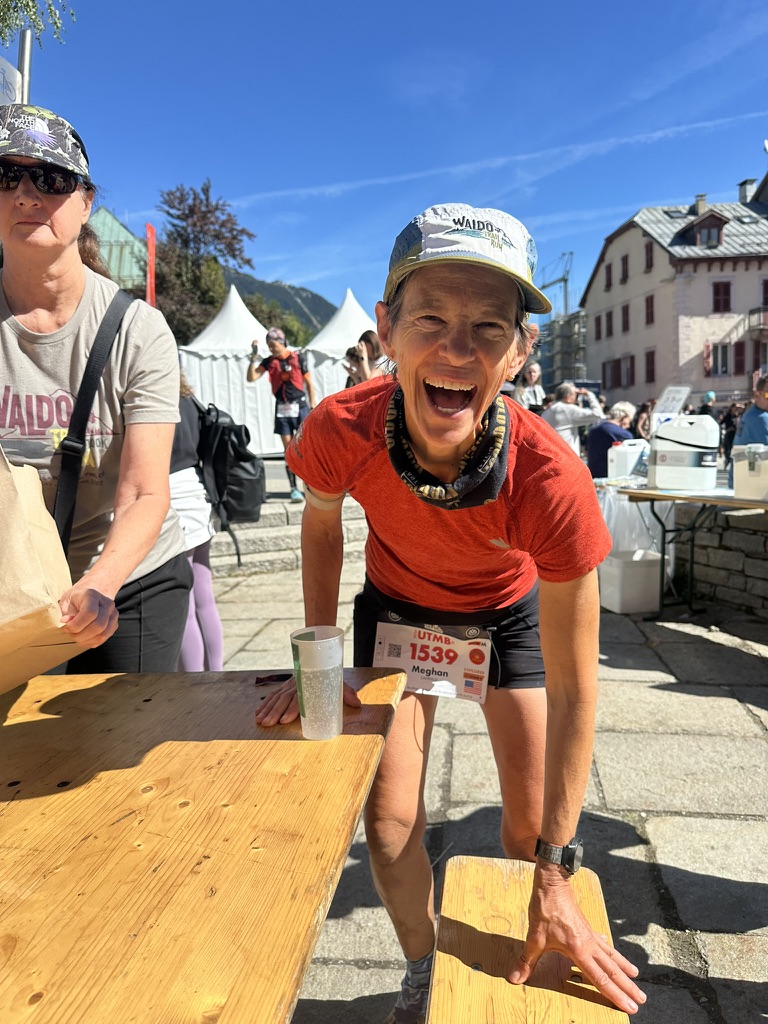

This race is one that I spent two years training for. I had completed the loop one time, had finished a shortened version due to a storm and had one DNF. Even when I finished in 2013, I was pretty unprepared, or I should say ridiculously unprepared for the terrain of les Alpes. I hired a coach, Leif Godberson of Evoke Endurance, as somebody who is experienced in navigating mountain terrain, and vertical challenges that I don’t have available to train on here in Oregon. Left to my own devices, I don’t have the confidence that I could have trained as specifically as I did with Leif. I had attempted one of the UTMB races last year, the Sur les Traces des Ducs de Savoie, (TDS) and had to stop at mile 80 of 95 due to a strained hip flexor. I spent the next year building off of what we started plus visiting my PT on a more regular basis, getting me to the race in good shape.
I went out to Chamonix Valley about 2 1/2 weeks before the race to reacquaint myself with the long steep climbs that I would be encountering during the race and to eat as many good baguettes and croissants as possible. I ran a fair bit of the last 20 miles of the course as well as the first 14 miles. I had some recollection of the course from when I ran it 13 years ago and mostly recognized just how long the climbs are.
About a week before the races started, the town of Chamonix and Les Houches (where I was staying) definitely picked up in the number of runners trotting around on the streets with their packs and poles, and the excitement definitely rose few levels. I didn’t get too wrapped up in any of the activities but focused on getting the things done that I needed to while following all the other races that were happening during the week. I did, however, enroll in one of the research studies being conducted during the race – a sleep study measuring stress, sleepiness, alertness, and a few others (subjective) and a response test (objective) that would be conducted at a few of the aid stations.
Finally, race day arrived, or should I say race evening, as it was scheduled to set off at 5:45 PM – and due to potential storming up at the higher elevations, the start was postponed for two hours.

Above – a graph of the course with elevation and distance.
Below – a topography of the loop around Mont Blanc.

At 7:15, I squeezed in with the masses of a good 2000 trail friends and watched the elite runners as they were individually introduced to the pulsing crowd. A light rain was subsiding, and the temperatures were very comfortable.
Finally, the countdown was on and off we went through the town of Chamonix. The crowd lined both sides of the streets, all the way out of town. It felt like a hero’s parade with all the cheering – it was quite an experience! It felt like we were winning rather than just starting our epic journey.
After about 2 km, I heard some voices shouting out “a gauche! a gauche!” – “to the left! to the left!” as there was a team of guides that were that were assisting a person in a wheelchair for a category called “team adaptive”. It was allowing some wheelchair bound folks the opportunity to experience the loop around Mont Blanc. It was pretty unbelievable, honestly, to imagine that they were going to go all the way around. As they went by me, I could see they had long straps to help pull the chair when it got tricky.
The first few kilometers are fairly flat and a lot of was on payment, still surrounded by spectators cheering us along. I ran nice and easy, over the fairly benign climb into Les Houches, getting my legs warmed up for what was ahead. It was already dark as we ran through the little town. At the far end, we began our first major climb, starting up a gravel ski road. The crowds were still quite thick – it felt like everybody was having a party and we were their entertainment! Maybe that’s exactly what it was. Eventually, as always, we made it to the final top of that first climb of Col de Voz and began the descent. It started down stupidly steep on a grassy trail – I had run down this last week and sharpened my skills so that I danced my feet very quickly to stay in control without putting on the brakes, skittering past several runners. The slope mellowed and the long descent took us into San Gervais, about 23 km in. The town was electric with spectators which put a smile on my face to have so much cheering.
Into the aid station, I quickly pulled out my bottles to fill with the race provided sports drink – Näak. I ran up to a volunteer with a pitcher in his hand and I asked if it was Näak. He said no – it is at the other end of the tent. So, I trotted down to the other end of the long tables and asked for Näak and they answered was no it’s at the other end of the table, so I went back to the other end and told the man and he gave me a blank look. I asked the woman next to him and she said “oh – we are out of Näak”. Well, that was not a very fun surprise, and I spent a few minutes being a little grumpy about it – especially since that was what I was counting on for the race. Instead, I filled one of my bottles with Coke and the other one with water. The rain had stopped and I took my jacket off and stuffed in my pack. I really need to use the bathroom so I asked where the toilets were. “at the end of the aid station.” I ran out again to the cheers of the crowd, looking for the toilet, never did see it and just kept going. I reset my attitude regarding my resupply to that of gratitude for being here and grateful for all the volunteers, whose fault it wasn’t that they ran out of sports drink. Eventually, when we were out of town far enough, I turned off my headlamp and went way off the trail and squatted by the bushes.
Back up and running, I was quite pleased with my energy. I kept it nice and relaxed but happily ran along. Even on the narrow trail and on some climbs, I passed several runners without overexerting myself. Finally reaching Les Contamines (32 km), I was happy to discover that this aid station did have Näak and so resupplied and trotted off to the next climb. This section included a pretty long stretch where we were required to have our lights set on the red beam as we were going through a nature preserve with sensitive wildlife. This section is also on the remains of ancient Roman road that has a lot of really wide slab rock, and a lot of broken up rock. Some of it was a little technical and using just red light, (mine in particular), it was a little bit slower than it probably would’ve been. After about an hour of climbing, it was cool to turn around and see a stream of red lights coming up the mountain side.
Once we got to the next col, we were allowed to go back to white light. The climbing wasn’t quite over (never trust you’re at the top of anything in this race!) and the next section rolled up and down with a lot of bouldering types of steps, which, surprisingly, I actually quite enjoyed. The descent finally started at Refuge de la Croix du Bonhomme, into Les Chapieux, a remote high-altitude alpine hamlet in southeastern France, still in the dark. This was just over 50k and not quite 10 hours in. During the next climb, up to one of the highest points to Col de la Seigne (about 2200 meters, or over 8000 ft) – right on the border of France and Italy – the sun came up and I could see the line of runners before me, and the peak eluding my vision by hiding behind the turns in the trail.
The descent took us down into the Val Vany. I looked to my left, and my spirit soared at the view – the mountain range felt enormous, and that I had been transported here in some otherworldly fashion, as I floated into the aid station at Lac Combal (67 km). I repeated my routine having my bottles filled with Näak.

The next section started off on a runnable road to a single track to begin our climb to Arête du Mont-Favre, another long climb where we encountered many hikers who were perhaps hiking the TMD (Tour de Mont Blanc) and were probably getting a little bit annoyed at having to get out of the trail.

The runners I was around and myself were as polite as we could be, knowing that it could be quite irritating and that we all need to share the trail. We even passed a pack mule completely loaded down with supplies for one of the groups. He seemed a little bit reticent at times, and the guide was definitely having the pull him along.

After the summit, we ran down to Checrouit Maison-Vieille, a lovely Italian aid station where the very Italian women tried to serve me lots of pasta and good sauce – I accepted sans the cheese – just not quite ready for that. I ate it under a tent chatting to a charming Italian man, asking him about the leaders, while he encouraged me to keep eating, then pointed me to the trail that descends into Courmayeur.
This part I recognized from training for TDS last year, and I was looking forward to what I anticipated being a pretty straightforward road descent. I was to be disappointed. We ran to a ski lift and then we were led to single track. I classified this descent as the worst one of the race. It was narrow. It was really steep. It was full of switchbacks, roots and rocks and toe jamming slopes. I ran this descent in 2013 and wrote about it, however it was in the dark that time, and I had younger legs. We finally reached the town of Courmayeur, halfway around Mont Blanc (81 km), and into the aid station.
Here I was met by the organizers of the sleep study who asked me what they could get me while I answered some subjective questions and then sat at a computer for a response time test – 3 minutes of clicking whenever I saw a red dot, and my response was measured in milliseconds. The sports center was cramped with people and they knew how to quickly get what I needed. I ate a cup of soup with noodles, and took off my tights and my long sleeve shirt as it had gotten quite warm and sunny out. It felt nice to be free the clothing. On my way out I was bombarded by some young volunteers enthusiastically offering to spray me down with sunscreen for which I was very grateful.
I ran up the cobbled and paved streets of Courmayeur and as I got close to the trail head, I saw the familiar face of Andy Pasternick, the medical research director from Western States and his wife, Joanne and Joanne‘s mother and Tammy Hew-Butler. When they saw me they were very excited, jumping up and down, cheering for me, and I yelled “I have fans!” It was a truly uplifting moment.
Getting on the single track out of town, I slowed my roll, keeping in mind how much climbing I had left to do. I basically inched my way up and allowed several people to go around me. This section was almost like going up stairs versus a smooth trail and I told myself “Go as slow as you have to go in order to have a strong finish.” I finally reached refuge Bertone (87 km), where many of the runners who had passed me were now laying down in the grass enjoying a relaxing time. I took my time to get my bottles filled and to drink a little more while at the station. I then began the hike out to hit a rather flattish section that would go on for about 7 km all the way to refuge Bonatti. It was up here that I encountered another of the adaptive runner teams. It was amazing to me that this group of people was getting a person around on this course in a wheelchair. We were fairly spread out now and I was moving comfortably. My energy and fitness felt on point.
At the end of the flat section, we descended to Arnouvaz (99 km) in the Aosta Valley. I fueled up inside the aid station and saw there was live race coverage on a screen – the top men had finished, and the top three women were getting close. I was absolutely thrilled and surprised to see that my friend Emily Schmitz, an American living in Les Houches, was coming in 3rd! Later when I spoke with her, she said everything just clicked and no one was more surprised than she. With that uplifting bit of news, I began our longest climb – the Grand Col Ferret, which marks the border between Italy and Switzerland. I kept myself in check, never flagging, just steady, steady, steady, never tiring of the views to my left of the magnificence of it all. Each time we came around a bend in the trail, and I could still see runners above me, rather than internally complain, I just described it to myself as “we’re not there yet”. I was very grateful for the training I had done to prepare me for this.


On the descent I was moving comfortably enough when a young woman caught up to me and began a conversation. She was also in the sleep study and was the mother of some young children. We hit a nice pace and decided to stay together. It was super helpful and the conversation helped pass the time. Her name was Sarah, an expat living in the Chamonix area, and this was her first 100 miler. She was wanting to get to the next aid in the town of La Fouly quicker, so she could breastfeed her baby. With a new breast-feeding policy, her crew was allowed to come into aid stations with the baby – a great positive move for the race that further helps women be included in this sport.
Before we got to La Fouly we agreed that it would be nice to have each other as run buddies for the rest of the race if it worked out. Just before the aid station (114 km) her husband and three daughters were out waving us in. Inside the aid station it was hot and loud and smelled bad – I mean we had a lot of sweat going on between all the runners and the roughly 70 miles we had covered. I tend to get a little lost in the aid stations trying to figure out what sounds good – I found some rice that I had broth added to, but the rice was so hard I couldn’t manage it. Then I spotted a Swiss couple making small plates of raclette – melted cheese – that would be served with a potato and a pickle. I had no desire for the cheese or pickle, but I was pretty excited with the prospect of a potato. I asked the kind man, if I could have just a potato. No. Only a plat du jour. Given that would give me 2 items I didn’t want to eat and one very small potato, I walked away. I got my bottles filled and as it was getting dusky, decided I should start drinking a bit of coffee going into the second night. Sarah needed more time and told me to just leave without her, and she would try to find me later. I was getting a little bit chilly so put on a few warm clothes and decided I had better keep moving.
This next section was slightly downhill and it was runnable. I was so pleased with how my legs felt and worked. With the help of runners around me – although we were finally fairly spread out – we all made it through a small town finding the markers almost like hash running. We finally hit the trail – a 3 km climb that was long and rocky that finally took us up and then over to the cute lake village Champex Lac (138 km). The sleep study folks were here for the subjects to do another response time test, and while I did so, they again got my bottles ready for me. Sarah had not caught up with me at this point, but I knew I needed to just keep moving. I started walking out and realized I had paid no attention to how far the next aid was. I asked a couple of men in the race – they didn’t give me a distance but said four hours. I thought wow, that seems long.
The first part of this was in the trees and not terribly unrunnable, but it was dark. Then we began to climb. I was pretty excited because I knew at some point in this section I would catch up to the point I had been on just the week before, and I would know what the rest of the race was going to be. We finally crested and as we were coming down, I was thinking – “oh this is where I was just last week”. I’d look at my watch and think the two men had been far off the time prediction. This was followed by the thought “boy I don’t remember this rocky section” and then I realized well it’s because I wasn’t actually as far as I thought I was. This went on for quite some time, even when I could see lights below and thought we were close to Forclaz, which sits above the next aid station, I realized I had not been out near as far as I thought. I caught up to a woman who was delicately getting over the rocks and asked me if I wanted to go around. I said no, it was just a slow section and soon it would level out. And it just kept going. We finally did hit familiar trail, but it was still rocker than I remembered – accentuated by my headlamp illuminating the rocks to a bright white, surrounded by darkness of the ground below – which made me more timid than I liked. But I’m also sure it had something to do with how many miles I had my legs at this point.
We came to a water only aid, really close to a cattle barn that was a bit on the smelly side. I didn’t need anything, so I kept going and the volunteer said it was 5 km down to Trient. We finally got to Forclaz and from there it was quite an easy run and descent into Trient – the Swiss village with the pink church.
This was another sleep study stop. One of the questions we are asked each time is “have you slept at all?” and “are you planning on sleeping?” As I have never slept in a race, the interviewer said that most people in the European races do stop and take naps. She also said if she were going to do an ultra that involves sleep, she would never sleep inside one of these sleeping tents or use one of these blankets because they were so disgusting by the end of the race. I finished the test (my response time was noticeably slower and took more focus as at this point, 28 hours in, I had been awake for 38) and then went into the aid station, ate some soup and loaded up my bottles and was on my way. This time I certainly knew the rest of the course. Ahead of me next was probably the steepest climb of the race, but it was not nearly as long as some. I started to go a little bit hard and then realized that it wasn’t going to be sustainable. A couple of men behind me got right on my heels, so I pulled over and let them go by only to find them sitting on the side of the trail about two switchbacks later, having a bit of a rest. So we played that game a little bit, and I was pleased to have kept my effort sustainable. It was getting close to the next morning and when I started the descent where I had encountered my lovely flock of sheep a week before. It’s a nice descent – however I was starting to struggle a little bit with the whole being awake for however many hours at this point. I kept shoving the idea out of my mind of stopping to take a nap at Vallorcine, which was the next station. At the same time, it sounded so lovely to just close my eyes for a little bit. And the other part of me would say “well then how long do you think you would stay asleep?” and “how’s it going to make you feel when you wake up?” and “are you going to want to keep going or are you going to want to quit?”. While I didn’t feel particularly unsafe. I also was aware that I needed to be extra careful with just my level of alertness. When I finally descended into Vallorcine (155 km), it was now light. And just as I had hoped, the second sunrise woke me up a little bit. It also made me feel just a little bit nauseous and I realized I was having a hard time getting calories in. I wandered around in the station and the only thing that looked remotely good were some crackers. I grabbed a handful and walked out of the aid station, nibbling on them and found that they settled my stomach and I could drink more calories.
I didn’t really want to have any time goals for this race – the older and slower I get, the harder it is to make predictions. I had a range of time that I thought was a reasonable expectation if everything went well. That range was to finish between 33 and 40 hours – I know that’s quite a long range, but I am a different runner from 13 years ago. This was uncharted territory in terms of how long I’ve ever spent doing one event. I looked at my watch, and I was now at 35 hours, and I had 17 km to go. I didn’t want to care, but I couldn’t help myself – I was unsure if I could actually run 17 km in five hours, but apparently I sure wanted to be under 40 hours. It seems a little bit crazy to doubt it I could do it, but I knew that I’d have to do more than walk because there was still another climb and a descent that was very difficult. I found my body sort of taking over and saying well, let’s do this. And so, I hiked hard and ran when I could, and when we got to the climb, I went up solidly. I never got discouraged, but the following descent (I classified as the second worst) was probably slower than the climb. The drop-offs and step downs were very challenging, even for me who has relatively long legs. I felt like this had been put in the race as mean trick to see how hard the race could be made. When I finally popped out at the bottom, we were off for more climbing. Even though I had done this section the week before, I really had completely forgotten how long this climb would become. I was super motivated though and worked hard as if the top were around the next corner. It was never around the corner. I saw a runner ahead of me and every time I thought he was getting to the top and I would hallucinate some object that would indicate that it was the trailhead he would turn to keep going up and that object would disappear. Of course, we finally did that to the actual real sign that put us out onto the open section and service road up to La Flégère at last.


I had worked really hard to get there and now I had sort of run out of gas. I found a gel and started to nibble at it, and it helped me get to the tippy top. When I tried to swallow the last little bit, I almost had my very first ultra marathon puke. So I did not try to finish it and stuck the sticky mess into a pocket.
The last aid station was La Flégère and the sleep study folks were there. I told them I didn’t want to do the final test because at this point it looked like I could even run under 39 hours. My competitive mind just would not let go. She asked me the subjective questions and while doing so I took off my warm clothes again because it had gotten quite warm.

When we were done, I headed off down the gravel road just letting my legs go. I was so pleased to be able to run and when I got on the single track I caught up to another runner, Stieven, who asked me if I wanted to go around – I said no because I really liked his pace and didn’t want to lose a tooth. He was moving at a very good clip which allowed me to focus on where his feet were landing and I did not have to think over the technical bits. We continued on this way for about 3 miles when we finally hit a bit of straight gravel road and I just let her rip. I thought maybe Stieven would keep up with me, but he did not. I was so excited and got down to the very bottom to go over the makeshift bridge that had been put in for the race to go over one of the main roads. And then I was in town on very flat pavement. And boy did I feel flat – yet so close to the finish. I knew I might as well just keep pushing hard. I made my way along to the cheering crowd and I looked up at Mont Blanc and my eyes welled up thinking I fucking made it around this mountain. And then looking back to where my feet were going the tears never came, all the drama was gone, and I was just happy.

Just before the finishing line I spotted Craig on the sideline cheering for me, and then around the corner I went, under the arch where the announcer said “here is Meghan Canfield and she will be on the podium as she has just won the 65 to 69 age group category. And you don’t look a year over 40”. I could’ve hugged her. I may have.

I was so happy to have completed the loop, so satisfied with how the training paid off, and content with my decision to not run this race again. I found the technical downhill rocky sections too stressful to really enjoy, and if you can’t have fun….

